
San Augustine Parole Versus Probation
Parole is conditional community release during an unexpired TDCJ sentence. Mandatory supervision is also a TDCJ release status, but its eligibility and decision rules differ. Probation, called community supervision in Texas law and court records, is imposed by a court. It may follow a jail term or begin without a TDCJ prison stay. None of these labels means the full sentence has been discharged.
The agency split matters. TDCJ and the Texas Board of Pardons and Paroles control state parole matters. The San Augustine County court and Adult Probation office handle local community supervision. A sheriff release sheet can prove when county custody ended, yet it will not replace either agency's supervision record.
| Status | Who creates it | Best verification |
|---|---|---|
| Parole | Texas parole decision during a TDCJ sentence | TDCJ offender detail, BPP status, parole office |
| Mandatory supervision | Texas statutory release process | TDCJ status, release certificate, IVSS |
| Probation | Local court order | Filed order and San Augustine Adult Probation routing |
| Discharge | End of the controlling sentence or supervision term | Agency discharge record or court order |
Verify San Augustine Release Supervision
Start with the source of the sentence. A person released from San Augustine County Jail on bond may have a pending case but no probation order. Someone who completed a county sentence may have no supervision at all. A person transferred from the jail to TDCJ remains in custody, and any later parole status belongs in the state system.
- Use the TDCJ offender search for a state-prison case. Match identifiers, then read the location, release, and parole fields literally.
- For a parole review, call the BPP status line at 844-512-0461. It can report whether review is pending, the last decision and date, and a next review.
- For probation, obtain the filed community-supervision order from the proper San Augustine court and contact Adult Probation for permitted case routing.
- When the status is unclear, request the sheriff release record or TDCJ release certificate. These distinguish community release from transfer.
- Confirm the assigned office. Residence plans, interstate supervision, special caseloads, or reassignment can change where a person reports.
A missing online result is not proof that supervision ended. Name variations, old records, a transfer, or a system delay can all explain it. Use date of birth, cause number, TDCJ or SID number, and custody dates when available. The broader San Augustine County release search explains how the sheriff and court records fit this check.
San Augustine Supervision Office Split
Research for San Augustine County identifies two concrete offices, not one all-purpose supervision desk. Court-ordered probation routes to San Augustine County Adult Probation in courthouse Room 205 at 100 W. Columbia, San Augustine. State parole and mandatory supervision map to the Nacogdoches District Parole Office, Region I. This routing rule is the page's most useful local distinction.
Local probation
San Augustine County Adult Probation
100 W. Columbia, Room 205
San Augustine, TX
936-275-2681
Fax: 936-275-1069
snichols@1jdcscd.org
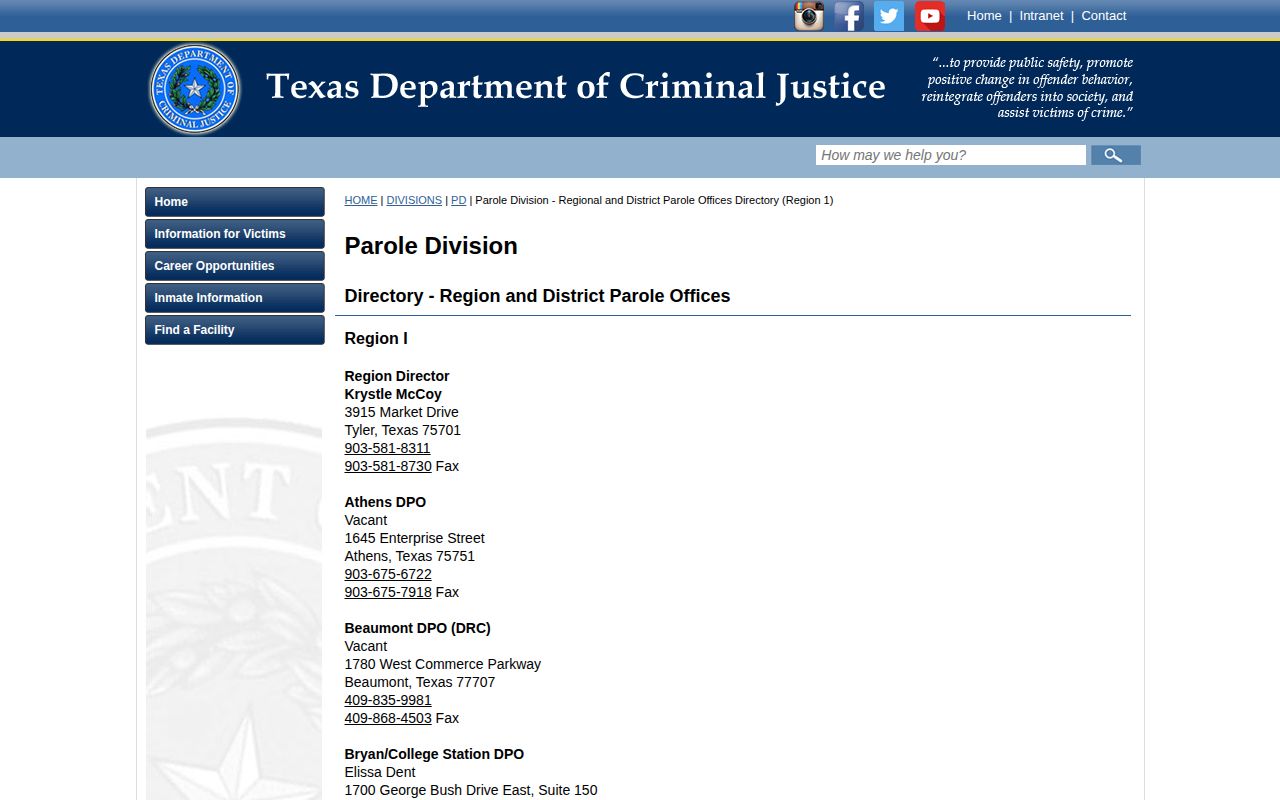
The TDCJ Region I office directory lists the Nacogdoches office at 1113 Industrial Boulevard, Nacogdoches, TX 75964, phone 936-569-6234. The image below shows the official district-office source used for this route.
Reporting frequency is individualized at the first visit and can later change. No research supports a standard weekly or monthly schedule for every San Augustine parolee. Call before traveling, and do not send a probation question to the parole office or a parole question to the county probation desk.
San Augustine Parole Review Records
Texas does not hold formal public hearings for ordinary parole or mandatory-release consideration. The Board says panel members review the file and vote individually, so there is no honest person-specific public hearing calendar to check. TDCJ identifies a case about six months before initial eligibility and about four months before a later review. An Institutional Parole Officer interviews the incarcerated person and prepares a summary.
A three-member panel votes in sequence, and two matching votes establish the result. Outcomes are more exact than a simple grant or denial. FI-1 points to release in the initial eligibility month and year. Other FI codes may set a later month or require transfer and program completion. A denial may set another review or require service of the remaining term within the governing rules.
Use the official BPP review explanation for the process, then use the TDCJ offender detail and status line for the person. Eligibility under Government Code sections 508.145 and 508.149 permits review; it does not promise a favorable vote or physical release. Even a favorable vote can be reconsidered or rescinded before release processing ends.
San Augustine Warrants and Absconders
A supervision warrant may arise after an alleged violation. It does not erase the fact that the person was previously released. Likewise, an absconder notation means the agency alleges that required contact stopped; it is not a new conviction by itself. Revocation proceedings are separate from ordinary parole review and may lead to arrest, a case-specific hearing, and a return-to-custody decision.
No county-published general parole, probation, absconder, or warrant list was located for San Augustine County. TDCJ has a narrow Sex Offender Absconder Information Search, but that tool does not cover all parole absconders or ordinary local warrants. The DPS registry is limited to people with a current statutory registration duty. For a local warrant, contact the issuing court or law-enforcement agency and use identifiers. Do not infer a warrant from silence in a web search.
San Augustine Supervision Conditions
Release conditions appear on the TDCJ release certificate or local community-supervision order. They can address reporting, residence, travel, programs, contact, or other case-specific duties. Conditions vary by order and can change. The correct answer comes from the signed record and assigned officer, not from a generic list.
Texas IVSS is an alert layer, not the supervision order. TDCJ operates a state IVSS for prison, parole, Board-decision, discharge, and post-release warrant events. County IVSS is separate. If a person moved from the San Augustine jail into TDCJ custody, the county registration does not replace a state registration. Alerts can help track change, but a missed alert does not prove that no event occurred.
When a violation is alleged, keep three dates apart: the original community release, the date of alleged noncompliance, and any return to custody. The first remains part of the release history. A later hold or revocation changes present status, not the historical fact of release.
San Augustine Supervision Discharge
Supervision ends through the mechanism that created it. TDCJ parole or mandatory supervision may end at sentence discharge, subject to the controlling law and record. Local probation ends under the court's order, completion, early termination if ordered, or another judicial action. A person who is no longer reporting should not be assumed discharged without the agency or court record.
Ask for the exact status and effective date. For TDCJ, the offender detail, incarceration history, or release and discharge record may supply it. For probation, obtain the docket and filed order. For county jail history, pair those documents with the sheriff's timestamp when the physical departure date matters. That record chain keeps release, supervision, and final discharge distinct.